If ever there was a seminal moment in the history of religion, one that left an indelible imprint on the development of Western civilization and profoundly shaped how people would understand their relationship with the sacred, the Council of Nicaea in 325 CE offers a compelling case.
From an epochal perspective, Nicaea brings into sharp relief a fundamental tension: the Yellow impulse seeking direct connection with a higher essence and living spiritual reality, and the Blue impulse seeking to organize human life through coherent systems, shared agreements, and canonical doctrine in service of stability and collective flourishing.
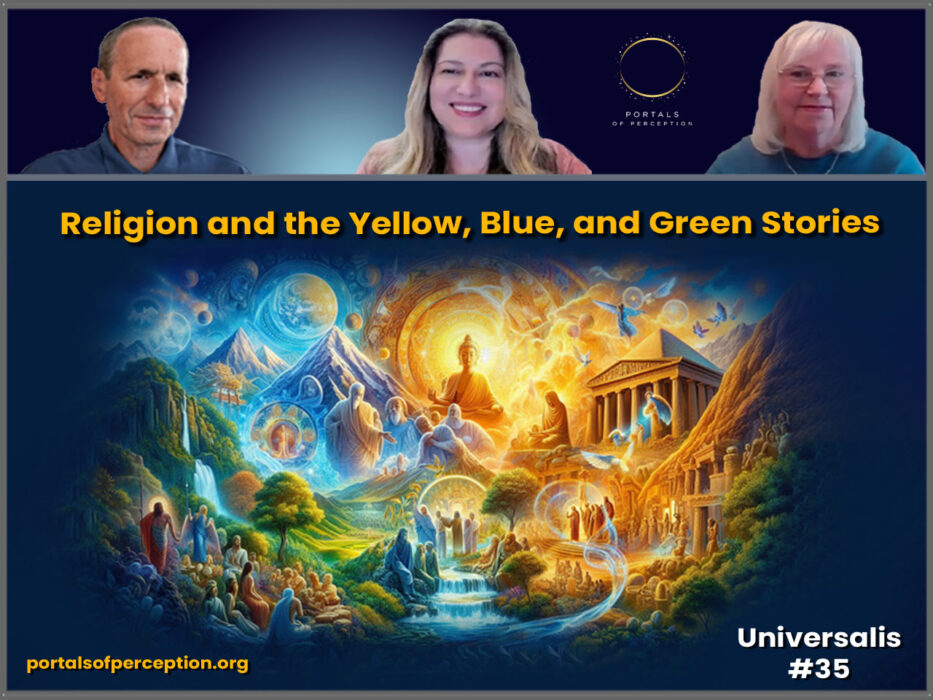
In this new episode, Religion and the Yellow, Blue and Green Stories (#35),” Aviv Shahar, together with Karen Heney and Kyriaki Nikandrou, continues the exploration of The Three Octaves of Religion (#33) and the The Hidden Purpose of Religion (#35) opened in the preceding Universalis conversations.
Aviv revisits the story of the Council of Nicaea through an epochal lens, exploring it as an archetypal expression of the Yellow-Blue tension that, in different forms, has accompanied humanity for nearly two thousand years.
On one side is the voice that says: “You are busy in the people business, but you have forgotten the essence. You are no longer re-tuning, no longer bringing the true communion.”
On the other is the response of the priests, rabbis, teachers, and community builders:
“If we cannot love each other, love our neighbors, and embody the Golden Rule, the beautiful essence means very little. It becomes an empty concept if it has no living expression in how we treat one another.”
These are not simply competing positions. They reveal two essential human impulses and two dimensions of a larger evolutionary story.
Can essence find an updated, embodied ensoulment that reconnects with its original arising, including the early experience of communion with angelic presence? And can that essence find expression through communion within small and large groups of people in ways that advance mutual human flourishing?
This is part of the Indigo-Violet conundrum of the moment. How are we to understand the religious and spiritual challenge of this epochal transition?
Aviv reflects that the historic frameworks of religion will continue to provide meaning, orientation, and communion for many. At the same time, increasing numbers of people are unlikely to settle within the inherited religious story alone. They are searching for new integrations: spiritual and
and individual communion, meaningful community in families and neighborhoods, and ways of bringing Eastern and Western approaches into a more complete ecology of practice.
At the center is an enduring human aspiration: to enter into communion with the supernatural and metaphysical dimensions of existence, and at the same time to embody that communion through a life of virtue, compassion, responsibility, and service.
The inquiry therefore moves beyond whether Yellow or Blue is “right.” It asks how their deeper functions can be recovered, renewed, and brought into a new relationship appropriate to the Indigo-Violet time.
Highlights from the Conversation
- The diversity of early Christianity. During the first centuries after Jesus, there was no single, unified Christian interpretation. Communities throughout the Mediterranean gathered around different fragments of the emerging story, local elders, teachings, practices, and understandings of what the life and message of Jesus meant.
- Constantine and the Blue imperative. Having granted greater freedom to Christians throughout the Roman Empire, Constantine confronted the challenge of growing theological conflict. From the perspective developed in this inquiry, his leadership imperative was distinctly Blue: how could a vast empire develop sufficient coherence to hold together? The Council of Nicaea becomes an attempt to recruit Yellow into the service of a larger Blue system solution.
- What becomes included, and what is left outside. The formation of canonical Christianity also raises questions about the more fantastical, mystical, and angelic dimensions appearing in some early Christian writings. Greater inclusion of these dimensions may have made it more difficult to establish a clear separation between Christianity and earlier naturalistic and pagan traditions, which were often closely attuned to animistic, vital, and invisible presences in nature.
- Nicaea as a seminal Yellow-Blue event. From this perspective, the Council of Nicaea represents a defining encounter between the need to preserve access to spiritual essence and the need to create a coherent religious and social architecture. Traveling forward to the 1787 Constitutional Convention in Philadelphia, we encounter another seminal Blue moment: people with different solutions and competing visions attempting to discover how a society might organize and govern itself.
- Yellow and Blue can each reach above the line. The inquiry proposes that Yellow and Blue need not be understood as permanently opposing forces. Throughout history, they repeatedly exchange roles and find higher expressions. At their finest, people carrying the Blue impulse have reached through Blue into Yellow, embodying humanity, humility, compassion, forgiveness, and love. Through the integrity of their lives, they summon a renewed communion that nourishes others.
The deeper possibility is therefore not the victory of one impulse over another. It is the discovery of how essence and embodiment, communion and community, revelation and organization can enter into a new relationship.
Perhaps this is part of the religious inquiry now opening in the Indigo-Violet time: What must be recovered from the original impulse of communion, what must be released from its historic forms, and what new ensoulment can enable essence to become fully alive in human relationship and collective life?
This episode continues the Universalis journey into the evolving frontiers of human consciousness, coherence, and capacity, exploring how deeper knowing can become a living force force and how its validation may be discovered in the experience and practice of life itself.
Information about upcoming special events can be found on the Events page. Also visit and subscribe to our YouTube channel.
In essence, can we get the epoch nudge for evolution to truly work with us and through us, to love each other and love the divine sources that give us life, and not see these as two separate conflicting persuasions, but as a unified persuasion, as a unified inspiration? Where we begin to see the divine in each other and where we realize that when we struggle with each other, we are faced with the opportunity to sculpt and shape ourselves in an even more refined and updated image of the very source we seek to emulate.

Karen Heney
From an early age there has been a compelling search for truths, those realities that didn’t have a fixing or a closed door. The quest for meaning, sometimes quiet, other times reaching and finding pathways, has always accompanied me. The awareness that all life is caused to exist for an inherent purpose, one that allows for the possibility of furtherance and refinement, has prompted both perceptions and questions. These concern the purpose of human life, its integration within greater domains and what I personally may need to discover in order to play my part. Creativity has always been integral, with an endeavour to create visual interpretations of concepts as practical activities. The intention behind a current project is to broaden the paths of relevance and meaning for others to access and explore.

Kyriaki Nikandrou
Aviv Shahar
Aviv serves as the Portals' sherpa. He curates transformational journeys and is a storyteller of the epochal evolution culminating at this time. Aviv is the Founder of Aviv Consulting, helping leaders unleash strategic innovation, and is the author of Create New Futures: How Leaders Produce Breakthroughs and Transform the World Through Conversation.
Visit: Aviv Consulting