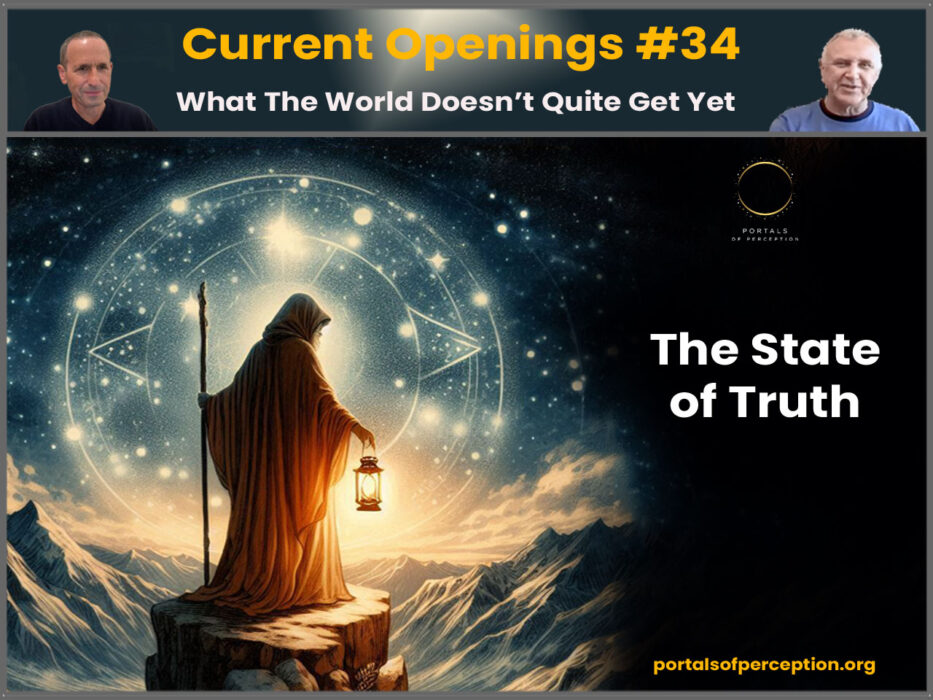
- 00:00 Introduction
- 2:52 How do we unlock the universal possibility of human life?
- 12:18 People are struggling on many fronts
- 17:55 Why does truth sometimes hurt?
- 39:38 Astronomy and astrology – what’s the real difference?
- 53:43 Truth as a universal property is getting lost
- 1:00:40 What about replacing stock market indexes with ‘truth’ indexes?
How do we even begin to think about the “state of truth” in our own lives and in humanity?
For some, truth may begin with what feels true in the moment: how we are feeling, what we can remember, or the immediate sense of wellbeing, coherence, or connection we experience with the world around us. These offer a personal and subjective entry into the inquiry.
From here, we can widen our contemplation. What if truth belongs to a much larger and more universal context? What if it can be sensed in the intelligence, energy, and natural order moving through every level of creation, including the human mind and heart, the living world, and the planet itself?
This wider perspective brings renewed depth to the question: What is the state of truth in our lives, and in humanity today? How do we recognize it, deepen our relationship with it, and allow it to inform how we live?
Helping us to ponder and explore this vast and living domain of truth are Aviv Shahar and David Price Francis, in the newest conversation in the Current Openings series.
The question itself is not new. What may be new is the urgency with which it now presents itself.
Aviv and David trace humanity’s search for truth through history: from the early embodied expressions of music, rhythm, and dance; through the emergence of mathematics; and into our attempts to understand the larger cosmic order through astrology and astronomy.
It’s also easy to see how much of modern life is disconnected from a natural and healing truth; there is pain and struggle on many levels, personal and collective. The ability to retether to a universal truth will determine our future wellbeing, and our capacity to integrate with the onsetting wave of evolutionary change.
Other insights in the conversation:
- A shift to thinking about ourselves as universal humans would mean a different model of life “essentials”: to food, clothing, and shelter, we would add the search for truth.
- What comes with primacy of the intellect is a self-aggrandized view of who we are as humans; we aspire not to live in harmony with nature, but control and manipulate it.
- As we break the universe into smaller and smaller sub-disciplines, we lose the sense of truth as a universal property that integrates all experience.
- In early cultures, the search for truth was inseparable from sustaining life and putting food on the table; the flow of life and the search for truth are joined at the hip.
- Mathematics emerged to help organize and codify the material world – its quantities, patterns, structures and shapes, in an intelligible, predictable, and manageable way.
- When we align with truth, not all problems and challenges evaporate, but more of the flow of life can find and support us. Truth and life are two facets of the same principle.
- We can process the power of joy and sorrow; the nature of clarity and confusion, but we're not these states. If we identify with them, the capacity for discernment collapses.
This conversation is part of the continuing Portals discovery into what is emerging on the frontiers of human experience in this time of profound change. Information about upcoming special events can be found on the Events page. Also visit and subscribe to our YouTube channel.
The further we move away from being in harmony with the permanent truths of creation, and as we move into delusion, into our own invented world, it will gradually produce more friction, more derangement of different kinds.

David Price Francis
David Price Francis helps individuals, couples, and groups understand and improve the quality of energy in their personal lives and relationships using techniques and strategies that he has successfully developed in private practice working with clients for over forty years. He is the author of Go With The Glow: From Psychological Pain to Spiritual Happiness; Partners in Passion: How To Positively Transform the Energies in all Your Relationships; The Tales of Dr. Woo: A Journey into Truth; and a 10-part online course, “The Human Aura: A Practical Introduction To Your Personal Energy Field.”
Visit: EnergyWorlds
Aviv Shahar
Aviv serves as the Portals' sherpa. He curates transformational journeys and is a storyteller of the epochal evolution culminating at this time. Aviv is the Founder of Aviv Consulting, helping leaders unleash strategic innovation, and is the author of Create New Futures: How Leaders Produce Breakthroughs and Transform the World Through Conversation.
Visit: Aviv Consulting