A Preface
This writing is inspired by the Portals conversation “What Blocks the Human From Its Greater Possibility? - Universalis #26,” in which Aviv Shahar, together with Karen Heney and Kyriaki Nikandrou, continues the exploration begun in the previous episode, The Examined Life: An Esoteric Trace - Universalis #25.”
In both conversations, the inquiry is forensic: Where are we in the Universalis journey, and what brought us here? The aim is to trace the living, causative roots that propel and nourish this endeavor.
In Episode #25, Aviv demonstrates a Socratic process of examining one’s life – a practice in which we revisit critical, formative moments, release them from their purely subjective framing, and observe them as objects. In doing so, we free them to be seen through the lens of today. This includes unresolved struggles and pain, as well as inspirational and breakthrough experiences.
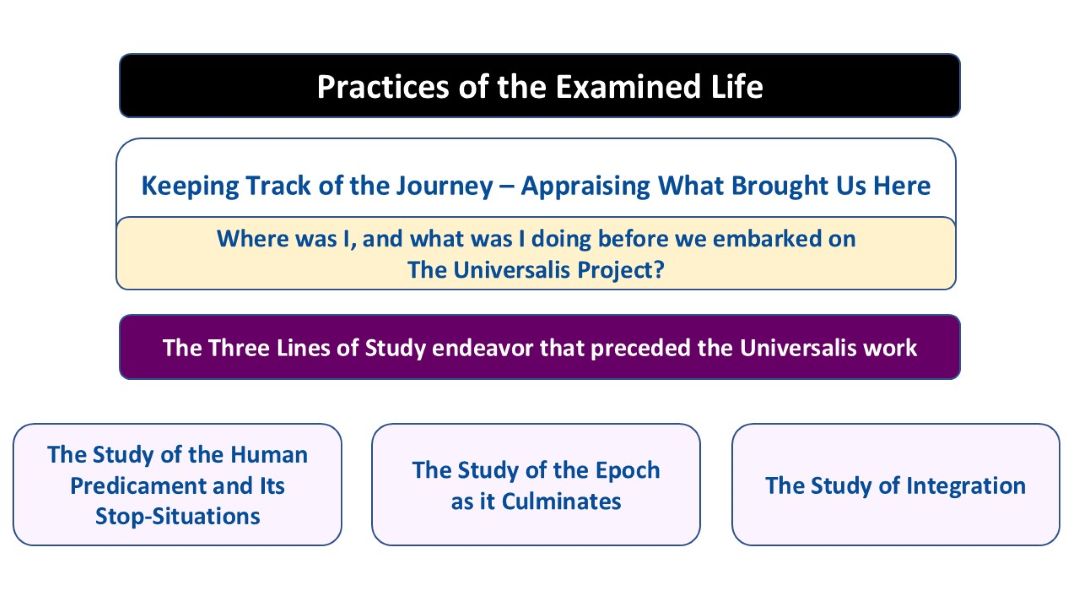
In this Universalis #26 conversation, Aviv traces the “Three Lines of Endeavor” he was engaged in before embarking on the Portals and Universalis projects:
(a) the study of the human predicament and its stop situations
(b) the study of the epoch as it culminates
(c) the study of integration
We have explored extensively the study of the epoch as it culminates in several Universalis conversations and writings. The study of integration requires a deeper dive of its own in the future.
In this writing, we focus primarily on the study of the human predicament and its stop situation scenarios.
Where We Are and How We Arrived Here
Whenever we attempt an effective appraisal of the inquiry, “Where do we find ourselves on our journey?” whether in a research endeavor, a project, or a phase of our own life’s development, we need to forensically examine what preceded it. To illustrate this point, Aviv examines and lays out what he was exploring before embarking on the Portals and Universalis adventure together with others.
This process is very different from reminiscing. It gets activated and becomes revelatory when we survey our life as an object, applying the Socratic exhortation that “the unexamined life is not worth living.” In this practice, the experiences and searing moments of our lives cease to be like frozen pictures in an album. Instead, they become living portals and opportunities for healing, transformation, and renewal.
This is an esoteric way of tracing both our own life story and the larger human story. We place ourselves under thoughtful examination to discern why a moment occurred, what it truly means, and what direction or possibility it opens.
This practice is part of the life verification and validation system explored in Universalis #18 and #19, and in the writing New Ways of Knowing – Part 2: The Natural Integrated Verification System of Life. To further explore this process, we invite you to listen to Universalis Episode #25 and to the Portals conversations “Searing Moments and Their Transformational Power.” These themes will also be further developed in future chapters of the Portals Into the Soul work, particularly in what we call The Inner Conclave.
The Three Lines of Study that preceded the Universalis Work
The three lines of study that preceded the Universalis work, and that Aviv Shahar was immersed in for several years, were:
(a) the study of the human predicament and its stop situations,
(b) the study of the epoch as it culminates, and
(c) the study of integration.
The study of the epoch as it culminates has remained a central element of the Universalis project, and several of our explorations have been devoted to that inquiry.
The other motivating impulse that preceded the Universalis work, Aviv explains, was the need to integrate the different spaces in his life:
“Although I was successfully pioneering various spaces that felt important to me, both as a strategic consultant in the corporate world and as a teacher and ‘sherpa’ in spiritual endeavors, I could not see how these different aspects of my life were going to come together, as they seemed to be moving on parallel tracks.
"I intuited that there would have to be something beyond what I could see at that moment that would lift me into a higher form of integration. I probably said something like this in 2014 or 2015, in different ways. During that time, while studying the human predicament and its stop situations, and the culmination of the epoch, I was also deeply inquiring into the study of integration.”
What is integration? What is the anatomy of integration? Is integration something that is already in place, that becomes enlivened once we can consciously perceive it?
Often, integration requires a whole other octave of experience and a new elevated set of permissions. It involves other people. It involves a larger project or a larger problem within which it is not so much that we create integration, but rather that integration happens upon us.
A fuller exposition would be needed to explore integration and the nature of the ripening process. What actually occurs in ripening? Why is it an essential element of maturation? And how does it make integration possible?
We will leave this exploration for another time.
For now, let us proceed by focusing on:
The Study of the Human Predicament and Its Stop Situations
Aviv reveals that “I began to codify the study of stop situations in writing around 2013 or 2014. The nature of the work was that I started to name different scenarios, different cases within the broader human predicament. I tried to observe them forensically and assess to what degree they constituted a stop situation. Is it blocked by 95 percent, by 75 percent, or by 55 percent?”
This was not merely an intellectual or conceptual exercise. It required probing more deeply into the phenomenon itself. The first step was to name what appears in the landscape, and then to attune to it and conduct deeper explorations into each of the seven stop situation scenarios.
To begin with, the larger case, the overarching umbrella of the human predicament, is the growing recognition of the widening distance between the natural “as-was-meant-to-be” line of human life, with its inherent potential to join the evolutionary line, and the gravitational pull of the conditioned line and the divergence that human life has come to inhabit.
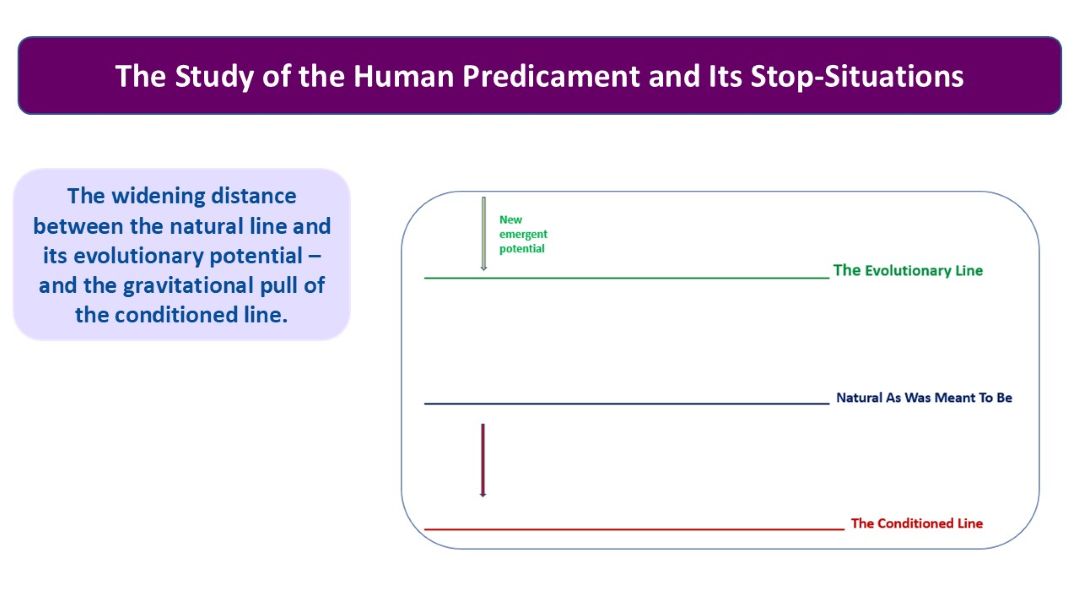
This gap, depicted in the diagram above in a simplified form, is increasing in every dimension of human life. It expands through the conditioning of contradiction, pain and subjugation, through accumulated traumas personal, familial, tribal, national, and those of the global human family. Over the course of history these layers have generated vast reservoirs of suffering and misalignment.
Even a new life entering the planetary experience is affected by this persuasion. A young life initially emerges on the natural “as-was-meant-to-be” line, permeated and enveloped by the presence of trust, the first plasma that allows life to experience itself within the planetary ecology. In many situations this state is interrupted very early. The pull of the conditioned line of modern culture often captures the young life before it has had the chance to stabilize in a genuinely supportive environment, ideally extending through the early years and toward the threshold of puberty.
Most young people therefore experience some degree of separation from the natural “as-was-meant-to-be” line early in life. For some, this separation is extreme, as in situations where a child grows up in a war zone. For others it occurs in subtler ways, such as being raised by parents who are loving but uninformed or unequipped. Even in supportive families, the cumulative forces of conditioning exert a gravitational pull. In contemporary life this pull is intensified by early exposure to digital and social media environments.
Everything else we are about to review here, the other six scenarios, can be understood as emerging from this first distancing and separation from the natural line of development.
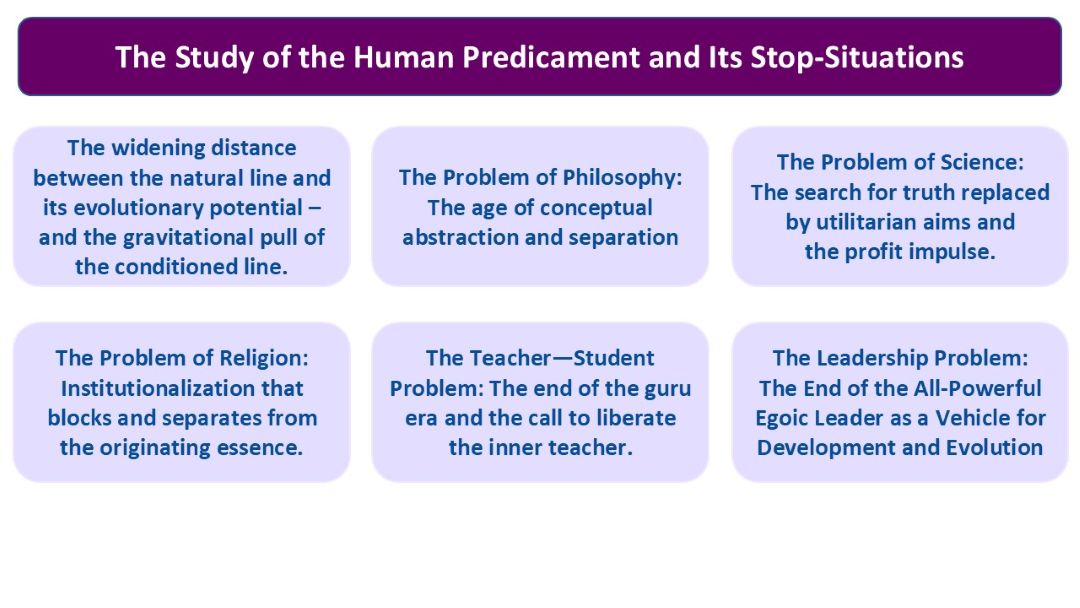

The Problems of Philosophy, Science, and Religion
The second stop situation concerns the problem of philosophy. What once began as philo-sophia, the love of wisdom, has in many instances become a discipline increasingly occupied with conceptual abstractions and obstructions.
Philosophy originally arose from a profound impulse: the desire to understand and respond to the primordial question of what it means to be human. At its core it was animated by the search for truth, knowledge, wisdom, and virtue.
These pursuits opened profound spaces of inquiry explored by extraordinary philosophers throughout the millennia, most notably in ancient Greece and within the great traditions of the East.
What we offer here is simply the testimony of our observation. We live in an age strongly shaped by the conceptual mind, where the capacity to abstract has progressively drifted away from life itself. Through the lens of The Sevenfold Epoch blueprint, we can recognize that the development of conceptual and abstract thinking was necessary. It enabled human beings to integrate greater complexity and to develop multi-perspectival consciousness. In this sense, it represented a major evolutionary gain.
Yet every development gain brings its shadow. Much of what has been codified within philosophy can now function as a barrier to the direct pursuit of truth, wisdom, and the virtuous life. The system that once served the love of wisdom gradually became a veil between the seeker and the living source of wisdom.
This leads us to the problem of science.
Following the Renaissance and the Enlightenment, and particularly with the emergence of the telescope and the microscope, modern culture began to privilege external instruments and external observation as the primary means of verifying truth. As this orientation took hold, other modes of knowing gradually receded from recognition. The interior sense organs and capacities of the human being were largely removed from the validation process.
Part of the Universalis inquiry has been an effort to restore and reintegrate these capacities. We described this attempt through the fivefold pathways of the natural integrated validation system in episodes 18 and 19 of the Universalis series.
Science has also been shaped by other forces. Economic interests, commercialization, and the pursuit of profit increasingly influence the direction of scientific inquiry. Alongside this, a persuasive materialistic and reductionist interpretation of the universe gained cultural authority. Academic systems added their own pressures, where recognition, prestige, and funding can displace the primary search for truth.
None of this negates the presence of brilliant and deeply ethical philosophers and scientists who remain devoted to the first-principle inquiry of their fields. Many continue to pursue truth with integrity and courage. Still, they often operate within systems shaped by secondary and tertiary impulses that limit the freedom to follow that inquiry wherever it may lead.
A similar pattern appears in the problem of religion.
Across the world’s great religious traditions we can recognize that each began with a profound encounter with a living essence. A pathfinder, prophet, or teacher entered into deep communion with a truth that revealed itself and sought to share that realization with others.
Over time, institutions formed to preserve and transmit that original insight. Yet the very structures meant to protect the originating essence insight can gradually become the ring that restricts access to it. What was once a living source may become concealed beneath layers of doctrine, ritual, and authority.
Again and again in history we encounter this pattern. A domain arises in response to a profound human need and is inspired by something perennial and true. Over time the structures that gather around it begin to obscure the very truth they were meant to serve.
We can observe this challenge across many traditions, including Christianity, Judaism, Buddhism, and others. We can first recognize the unique essence each tradition brought into the world and then discern the layers of dogma that formed around what was once vibrantly alive. A difficult question then arises: what causes systems of knowledge and organizations to form in ways that block access to their originating essence?
This inquiry requires humility and care. Before examining where blockages have formed, we must acknowledge the immense goodness, beauty, and wisdom these traditions have brought to humanity. Through generations, countless devoted priests, teachers, and practitioners have preserved and transmitted profound treasures of meaning.
Still, even while honoring these treasures, we cannot ignore a difficult legacy. Without pointing to extreme or fundamentalist expressions, many religious traditions openly acknowledge the blockages that have formed within their own structures. Thoughtful leaders within these traditions continue to explore these questions with sincerity and depth.
Thus the first stop situation concerns the widening gap between the natural line of human life and the conditioned line that diverts it from its evolutionary potential. Alongside it we encounter three additional stop situations: the problem of philosophy, the problem of science, and the problem of religion.
The Teacher-Student Problem and The Leadership Problem
The next two stop situations arise in close proximity and are therefore presented side by side, although each carries its own nuances.
(a) The teacher–student problem
The first concerns the teacher–student dynamic, with particular emphasis on the teacher’s side of the relationship. Historically, the role of the guru carried great significance. Over time, this archetype has in many instances become arrested or distorted. We appear to be entering a period in which the deeper task is to liberate the inner teacher within each person.
This does not mean that teachers no longer play an important role. Their function remains essential. What is changing is the archetypal nature of the engagement. Rather than embodying the all-knowing and all-powerful guru, the teacher’s role increasingly becomes one of guiding people to discover and trust their own inner teacher.
This shift calls for humility. It asks that teachers do not present themselves as infallible or as possessing all the answers. Their work becomes one of accompaniment and midwifery, helping others recognize capacities that are already present within them. In this way, both teacher and student are invited to move beyond patterns of dependency that historically formed in such relationships, allowing the encounter to mature into a space of shared inquiry and awakening.
(b) The leadership problem
The second stop situation concerns leadership. We appear to be approaching the limits of the all-powerful, ego-driven leader as a vehicle for development and evolution.
This realization is emerging at a moment when the world stage is filled with highly centralized and egoic leaders. In some cases, these figures operate primarily as vehicles for their own agendas, and at times they even become agents of systemic breakdown. The reappearance of older archetypes of leadership, such as the monarch or the strongman, can be understood as part of our confrontation with these patterns. One may naturally ask: how can we speak of the end of the traditional guru era when there are more gurus online than ever before, and when egoic leaders are gaining power and popularity?
A useful analogy comes from psychology. A person who has grown up under an authoritarian parent may later find themselves repeatedly drawn to similar authority figures. The pattern is not accidental. It reflects an unconscious attempt to resolve or release the earlier imprint. In a comparable way, humanity may relapse into autocratic forms of leadership that once traumatized it, until the underlying pattern is recognized and healed.
From that recognition a more mature form of leadership can begin to emerge, one that is more distributed, participatory, and conscious.
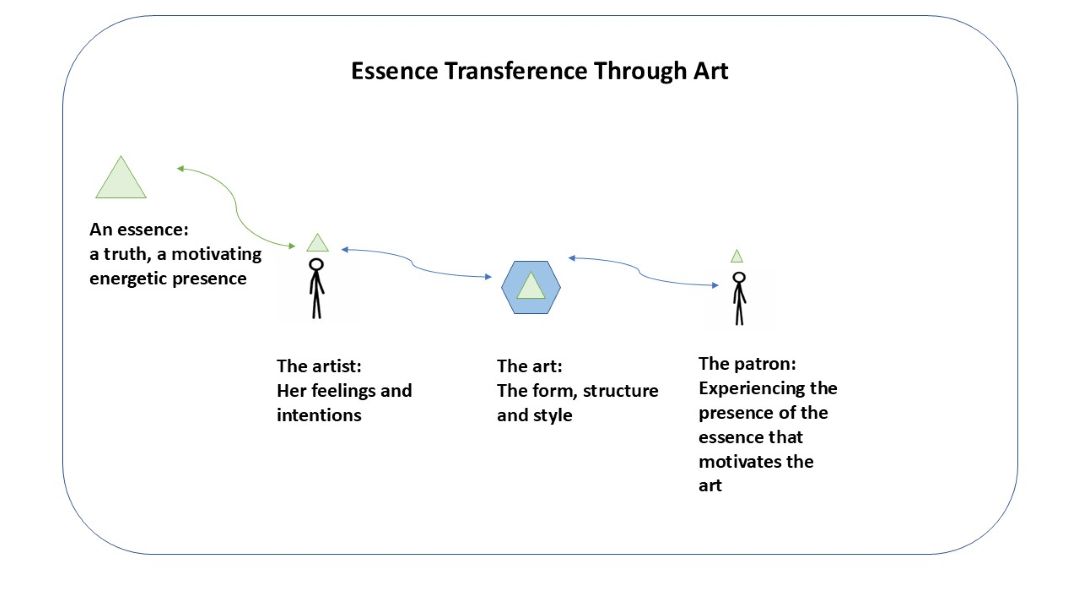
To examine this situation more diagnostically, we include below a diagram first introduced in one of the early Portals conversations. In that discussion we explored the idea of essence art and essence transference, seeking to distinguish between personal, ego-driven expression and what might be called true essence art.
This dynamic parallels the more detailed and nuanced account we explore in The Teacher’s Journey, where we also describe the phenomenon of the golden shadow. This material appears in Portals both in recorded form and in writing.
What the diagram depicts is the process by which an artist, through their feelings, intentions, and inner propulsion, enters a quest. In that quest they seek communion with something they long to express, a truth or energetic presence that calls them. From this communion the art form itself begins to arise: the structure, the style, and the expression of the work.
In actuality, several octaves unfold simultaneously in this process:
- The artist develops their craft and skill while searching to discover what it is they are attempting to communicate and connect with.
- In that search they make contact with something beyond themselves, something finer or higher, a source that inspires them.
- The art form becomes essence art.
- The work then summons the patron, the audience, or the followers of the artist, inviting them to encounter the presence or essence that originally inspired the work.
The essence the artist contacted can be transmitted through the work itself to the person who encounters it and seeks connection with that same originating source. The key point is that these represent distinct octaves within the overall process.
This same framing helps illuminate the stop situations of the teacher and the leader. In both cases, the teacher or leader, through their sentiments, motivations, and sense of purpose, enters into contact with a certain truth or motivating presence. That contact may carry genuine inspiration and vitality. Yet when the different octaves of the process are no longer aligned with that source, a subtle confusion can arise.
Followers may begin to attribute the originating source of inspiration to the individual rather than to the essence that moved through them. What began as contact with a deeper source can gradually shift toward personal identification, projection, and dependency. Recognizing the distinct octaves within the process restores clarity. It allows the teacher or leader to remain a conduit rather than the object of devotion, while inviting others to seek their own direct contact with the originating source.

When the teaching or leadership process functions well, it allows the student or follower to encounter the very presence that inspired the teaching or the cause being led. The role of the teacher or leader is therefore to serve as a conduit through which others may experience that originating essence.
The stop situation appears when a shift occurs. Even when there was genuine communion with the essence at the beginning, the teacher or leader may gradually become focused on themselves in a separating egoic sense. As this happens, the connection with the originating source weakens.
At that point the student or follower no longer encounters the essence, the truth, or the living presence that first inspired the work. What they encounter instead is the personality of the artist, teacher, or leader.
This is the teacher’s and the leader’s problem.
The Separated Consciousness and the Identification Problem
The seventh stop situation concerns separated consciousness and identification. It underlies the previous six and expresses the deeper gap between the possibility of connected, integrated living and the way human life is commonly experienced.
Aviv reflects:
“In my study of the stop situations there were many subcases within the larger pattern. When I reached number seven, I realized that I had entered a process where consciousness was researching consciousness. More specifically, my own consciousness was researching itself in the context of the human stop situation.
At that point I reached my own stop situation. I sensed that if I continued to push further without stepping back, the inquiry could become destabilizing. So, I paused and withdrew from the investigation. I only do this kind of work when my feet are firmly on the ground. And it is worth noting that all this was unfolding during one of the busiest periods of my consulting work.
In the story we are telling here about the study of the human predicament and its stop situations, this explains where I was and what I was exploring before we embarked on the Portals and Universalis journey.”
This background also helps explain why we propose that the discovery and unfolding of the Universalis prospect opens new pathways of possibility at a moment when the epoch itself is reaching a culmination. There is growing evidence that a new level of human consciousness is beginning to emerge, bringing with it new evolutionary capacities and developmental possibilities.
Universalis conversations #25 and #26, together with this writing, arose from the need to step back and ask what brought us to this point. The broader context of the Universalis project represents our best response to the human stop situations described here.
This reflection is offered without presumption or proprietary claim. Many people around the world are engaged in related inquiries. They employ different languages and frameworks, each expressing distinct facets of a shared emerging movement. Within these efforts there is a growing recognition that the underlying driver of the meta-crisis lies in the structure of human consciousness itself, the very form of consciousness that generated and continues to propagate many of these problems.
For this reason, part of the impulse behind the Universalis project arises from the recognition that technology alone will not resolve our civilizational challenges. Technology can assist in many ways. It can amplify possibilities and create new tools. Still, without engaging the interior capacities of the human being, technology by itself remains insufficient and may even deepen the challenges we face.
The Universalis research therefore invites the activation of latent human capacities, together with new capacities that are now ripening and coming into maturation. Its intention is to help liberate these possibilities and bring them consciously into human life.
If the underlying challenge of our time lies within the structure of consciousness itself, then the response must also emerge within that same domain. The deeper task before us is not only to redesign our systems, but to participate in the further unfolding of human consciousness. The Universalis inquiry is offered as a contribution to that unfolding.

A Problem Is Also An Opportunity
All these problems and stop situations also hold great opportunities. This insight is not merely captured in the well-known Chinese symbol that joins the potentials of crisis and opportunity. It reflects a deeper dynamic that becomes visible as we journey from the exoteric to the mesoteric and then to the esoteric. At a certain point in that journey a reversal becomes necessary.
One of the mysteries is why such a reversal occurs. What is the universal anatomy that requires it? This question deserves its own research.
An entry point into this contemplation is the recognition that we cannot carry the same toolset and the same mindset that produced a problem beyond the threshold of its resolution. In much the same way that we cannot carry the earthly riches we accumulate in this life into the afterlife, certain structures of thinking and engagement cannot accompany us into the next stage.
What allows us to look at a problem and discover the opportunity it contains, and in doing so release its grip?
The universe does not operate primarily through simple addition. Its processes unfold through multiplication, often through exponential development. Part of what allows such exponential movement is symbolized by the cross. At the crossing point, simple addition no longer suffices. A different process begins, one that involves shedding and letting go.
We touched on this dynamic in Current Openings #16 conversation with David Price Francis while exploring octave leaps and the study of elevation. The same principle is relevant here.
What becomes necessary is an alchemical transformation, one that rewires how we see ourselves and how we engage with the landscape before us. This is part of the reason we returned to Socrates’ admonition about the unexamined life. In Universalis #25 we invited a deeper exploration of what it means to live an examined life in the esoteric sense: to see oneself as the energetic template, the living tableau formed by the totality of one’s experiences.
Humanity is moving through another transition, another octave leap, and we do not yet know what lies on the other side. In such moments the work of appraisal becomes an imperative. It calls for humility, interior examination, and a willingness to release what no longer belongs and cannot pass into the next octave.
Part of this alchemical passage involves acknowledging things as they are and honoring what has enabled our journey so far. What enabled you, what enabled me, what enabled humanity as a whole to grow and evolve to this point deserves recognition.
Without honoring what brought us here, we cannot fully release what this moment asks us to release. Within the domains of life, philosophy, science, religion, teaching, leadership, and consciousness itself, there are extraordinary achievements we want to appreciate and carry forward.
At the same time, new permissions are opening. Entering them requires the willingness to release what cannot be carried forward. The movement resembles the metamorphosis of the caterpillar, which must abandon and release the cocoon of its former form in order to become a butterfly. Our genuine responses to what is now emerging may become the wings of our tomorrows and the flight of liberation as we draw nearer to the light. In that becoming we may participate in the exalted dance of the universe, giving and receiving the nectar of a more integrated consciousness.