In Chapter Seven, we reflected on the barriers preventing us from fully realizing our spiritual nature, noting how remnants of a 19th century mechanistic view of the world continue to influence us. We proposed that there is a profound liberation available through first embracing a quantum perspective of the world, and then by contemplating the material world as a realm where diaphanous Spirit- and Soul-like properties purposefully densify. This densification catalyzes the emergence of a bio-physical realm, providing life with a laboratory for discovery.
We then began mapping the inner landscape of the Soul, the Spirit, and the Self, offering a series of pathways and practices designed to attune us to the multifaceted natures and qualities of the Soul.
In this chapter we develop these insights to explore more deeply the rise of the Self and the pivotal role of the Spirit. We begin by introducing a fresh understanding of why this Portals Into the Soul journey is emerging precisely now, at a unique moment that marks a profound shift — a time of transition between epochs. To access and appreciate this realization, we embark on a meditative inquiry into both our ancient past and the distant, unfolding future.
Humans tend to become myopically biased when narrating the story of life. We interpret the world predominantly through our immediate experiences, assuming life has always largely mirrored our current reality, aside from some recent technological advancements. This assumption is demonstrably false. Life in earlier centuries — whether the early 20th, 19th, 18th, 15th, 10th, or the 4th century — was distinctly different in each period. Likewise, those living a century from now will indeed perceive and experience life through different worldviews, distinctive from those shaping our present.
One significant shift I foresee is the reintegration of the Soul into human consciousness. The coming century will bring remarkable opportunities to reawaken and re-embrace our Soul nature. This opening is already underway, urged in part by our recognition that intellect and advanced technology alone cannot adequately resolve the complex challenges we face. As these challenges persist, we find ourselves increasingly turning inward to rediscover the guidance and wisdom of the Soul. It is precisely within this transformative context that our Portals Into the Soul odyssey is taking shape.
Meditatively Abiding with Ancient and Future Times
Allow yourself to meditatively sense and experience life in the ancient world compared to the modern era.
Imagine, for instance, walking into the Parthenon atop the Acropolis in Athens around the year 430 BCE, shortly after its construction, built upon the earlier constructions and fortification walls, approximately 2,455 years ago.
Allow yourself to experience the awe and the powerful, visceral feeling of collective significance shared among those gathered in the temple. Dedicated to the goddess Athena, the feminine deity of wisdom, the Parthenon symbolized protection from war. Athena, patron of Athens and revered throughout Greece, was one of the twelve Olympian deities of the Greek pantheon. The Parthenon therefore served as a sacred space for communion with divine powers, inviting individuals to discover their highest human possibilities.
Now, invite your Soul to attune and listen to the Souls of the people entering the Parthenon. What did they feel? What experiences resonated with them? What hopes and concerns occupied their hearts? To truly sense this, you may find it helpful to meaningfully slow down and abidingly dwell with these inquiries, ideally by spending time on the Acropolis itself or by surrounding yourself with the imagery of it.
Imagine the atmosphere and the feelings infusing pilgrims during a festive celebration. In ancient times, people weren’t tethered to smartphones or besieged by the countless distractions we encounter today. Instead, prominent sacred monuments,  often situated on mountains or high places, stood in constant view, anchoring daily awareness and conversation. The ever-present visibility of these monuments created an ongoing inner dialogue about their meaning, imbuing everyday life with significance, value, and purpose.
Over many days of seeing these monuments from afar, people naturally cultivated reflective thoughts and gathered insights. When they finally undertook a pilgrimage — whether to Egypt’s pyramids, Athens’ Parthenon, Himalayan peaks in India, or the grand cathedrals dominating their communities — the journey became the culmination of prolonged contemplations. Pilgrims arrived bearing insights born from their ongoing connection to these places, deeply receptive to the living presence emanating from these sacred spaces. The Soul configuration in antiquity was more collective and less individuated. People did not experience thoughts and feelings as distinctly "theirs," as we commonly do today. Instead, thoughts, sentiments, and feelings were sensed as diaphanously surrounding and permeating their being, as part of a shared collective experience.
From a cynical modern viewpoint, one might argue this perspective romanticizes history, which contained an endless procession of pain, suffering, and hardship. While hardship undeniably persists as a feature across the human story, this modern critique often projects contemporary assumptions onto the past, overlooking the fact that past struggles occurred within distinctly different tolerances, values, and circumstances.
Modern intellectual arrogance tends to dismiss ancient peoples as ignorant and primitive, portraying them as unenlightened and trapped by superstition and mythic beliefs. This is a reductionist view that oversimplifies history. Undoubtedly, science has granted us extraordinary knowledge and capabilities, gifting humanity with powerful third-person objective understanding. Yet, in embracing these advances, we’ve sacrificed a certain permeability — a subtler, whole-person access to intimate and connective experiences and other modes of knowing.
As explored in the Universalis series, recent centuries have required our Soul orchestration to increasingly emphasize the head and the lower gradient of the mental portal in the brain. In this Portals Into the Soul journey, we combine two essential moves:
- Activating and liberating the higher gradient of the mental portal through contemplative and connective communion practices, and
- Reintegrating the whole human orchestra experience and its latent capacities, sensory processes, and knowing systems.
These moves do not necessarily offer instantaneous awakenings; they require sustained and abiding cultivation. The invitation in these practices is nurturing, developing, and activating dormant faculties and sense organs — crucial elements in the ongoing emergence of the Universalis Human.
This approach does not advocate regressing to the past or abandoning scientific advancements. Retreating along the timeline is neither practical nor desirable. Rather, our endeavor seeks to harvest the spiritual essence and devotion of the ancients, integrating these timeless nutriments within the contemporary evolution of the whole-person Soul-Spirit-Self.

From Backward- to Forward-Looking Meditative Inquiry
Similar to the meditative inquiry that brought our attention to the Parthenon, we can engage in a parallel contemplative focus with any period or occasion in history. For example, moving slightly closer in time, imagine yourself among the founders gathered in Philadelphia for the Constitutional Convention from May to September of 1787, aiming to birth a new nation. What was moving within them? What experiences did they have? Which sentiments motivated and guided their actions?
When you study the object of your inquiry, you are engaging more than your intellectual capacity to gather easily accessible facts. You ask your Soul to inquire into the experiences and feelings of those who lived in that era. Then you wait patiently, resisting the urge for instant answers or conclusions. Instead, you remain in a meditative state — connected to your inquiry for hours or even days — immersing yourself in the images and sensations of that particular time or event. Notice the subtle insights that arise as you gently ask, within a contemplative space of openness: What were their aspirations? What concerns and sentiments did they carry? What essence flowed through them?
After creating this contemplative space, you can choose to bring your meditative inquiry to the future. Imagine the world 20 years from now. A helpful method is to envision a beloved five-year-old child you know, and mentally travel with them 20 years forward when they become 25 years old. Observe and imagine the world  through their eyes, their experiences, their inner feelings, and the stirrings within their Soul. Remain contemplatively present with this unknown future.
You might even extend this meditative inquiry 100 years ahead; for example, as of this writing to the year 2126, or even 300 years to 2326. Allow your Soul the space and freedom to wonder deeply, abiding thoughtfully with these expansive inquiries.
This contemplative practice can be enhanced by dwelling in peaceful natural environments or by walking quietly, allowing yourself to become profoundly open and receptive. You are seeking to enter a realm that is clear, spacious, and expansive — free of crowded thoughts and openly extending beyond the horizon. Experiencing such peaceful spaciousness is deeply restorative to both Soul and mind.
Meditative inquiry into the future indeed is not about crowding your mind with restless thoughts. It’s a journey of opening to the boundless potential to arise within. As habitual, anxious thoughts recede, you step into an expansive space alive with presence, vibrant well-being, and ever-unfolding possibilities.
Envisioning the future can feel daunting. The first step, then, is to cultivate this inner spaciousness — a receptive field where fresh perceptions and intuitive insights can emerge. We cannot simply project ourselves 100 years into the future through today's narrow lens; doing so would only constrain the boundless possibilities waiting to unfold.
Without reference points for life in 2126 or 2326, we often mistakenly try to extrapolate from present conditions. Such extrapolations always fall short of true foresight. You could not extrapolate the 14th century from the 10th, nor successfully foresee 1940 from 1900, or 2000 from 1950 — and even not 2030 from 2000. Genuine insight arises from open contemplation rather than linear projection.
Why We Can't Extrapolate the Future
The first reason extrapolations fail is the singular dimension fallacy. When imagining the future, we often become susceptible to a narrow focus bias, typically emphasizing technological progression. Too many forecasts simply extend today’s tech trends, frequently depicting futures centered around technological solutions, assuming these developments alone will solve all our predicaments. While technology will likely advance significantly, this view overlooks essential interior human dimensions, the "technologies" and "sciences" of the human Soul and Spirit, and the powers emerging within individuals and societies.
The second reason extrapolation fails is the dynamics of nonlinear phenomenology, which compounds the singular dimension fallacy. Change rarely unfolds in a straight line; instead, it drifts through long plateaus of minor variations before erupting in sudden, transformative leaps that unlock a whole new paradigmatic possibility. The evolution of Artificial Intelligence (AI) offers a vivid example of this nonlinear rhythm.
 Forms of Artificial Intelligence have been explored before the mid-20th century. In 1947, Alan Turing first described computer intelligence in a lecture in London, stating, “What we want is a machine that can learn from experience.” He explained that allowing a machine to modify its instructions provided the foundational mechanism for AI. The following year, he outlined AI’s core concepts, yet AI remained relatively limited in its applications through decades of focused research from the 1980s into the early 21st century. Then, quite suddenly, driven by leaps in computational power and large language models, AI dramatically surged forward, exemplified by the explosive popularity of ChatGPT.
This example shows how technological development is inherently nonlinear, demonstrating that even compelling narratives extrapolated from recent trends will fail to accurately predict the timing and impact of future developments. This principle and the dynamics of a paradigm shift also apply broadly across cultural trends, fashion, perceptions, beliefs, and human consciousness.
A third, subtler reason extrapolating from current conditions will fail relates directly to the interior element and our inner experiences. Development and evolutionary changes are not solely exterior phenomena. The contemplation of the Soul and the Spirit invites us to recognize the profound interior transformations accompanying and catalyzing external shifts. These transformations reshape our beliefs and worldviews, recast our stories of meaning and place in the world, rewire neural patterns, awaken new sensibilities and sensitivities, and activate human faculties in ways unique to each historical epoch.
For instance, when we imaginatively and meditatively attune to those who first gathered at the Parthenon shortly after its construction, we intuitively sense how profoundly their experience differed from ours today. In the ancient world, watching fire, marveling at a rainbow, or joining in communal song and dance were porous, multisensory encounters, filled with vibrant subtle presences that deeply resonated through the whole person. These events were inherently collective and tribal, dissolving the boundaries we now draw between inner and outer, individual and group.
By contrast, our contemporary mode of experience is largely cerebral — conceptual rather than visceral, atomistic and isolated rather than communal and interconnected, and often virtual or simulated rather than directly embodied. We see therefore that changes occur simultaneously across several distinct dimensions:
- Planetary and environmental events
- Technological shifts
- Socioeconomic, political, and geopolitical transformations
- Maps of meaning and ways of understanding the world
- Activation and evolution of human sense organs and experiential faculties
- Soul presence fields and their energetic orchestration.
The Non-Chronological Way of the Soul
Our Soul contemplation of the future creates space for both interior and exterior dimensions of change to offer insight and intelligence. By integrating these dimensions, we begin to experience an inflection point. While habitual cognition typically perceives development as chronological and linear, the Soul deeply recognizes and knows that today is not merely a continuation of yesterday, nor is tomorrow simply a continuation of today. Rather than imagining or extrapolating the next moment from the current one, the Soul meditation reveals that the next moment arises not from the previous one but from a field of potential. This field is held within the universe's interior dimensions, just as the Soul itself is an interior dimension of human life.
This liberating reversal — allowing a future not defined by the past — is latent in the "Thou Mayest" message the Soul offers to itself, empowering the Self to become fully agentic in its emergent formation and organization. This is a paradigmatic shift, one that unlocks profound healing and transformative potentials and capacities.
I’m not asking you to take my word for it, only to suspend disbelief long enough to let your Soul explore this possibility before you make up your mind. You’ll discover that, while most people remain trapped in conditioned patterns that see tomorrow as nothing more than a continuation of yesterday, your Soul is not bound by those limits. This isn’t a fanciful New Age notion, but the genuine reality of the Soul and the Self, an actuality that honors the sequence of earthly events even as it remains tethered, through the Spirit, to a universal reality beyond linear time.
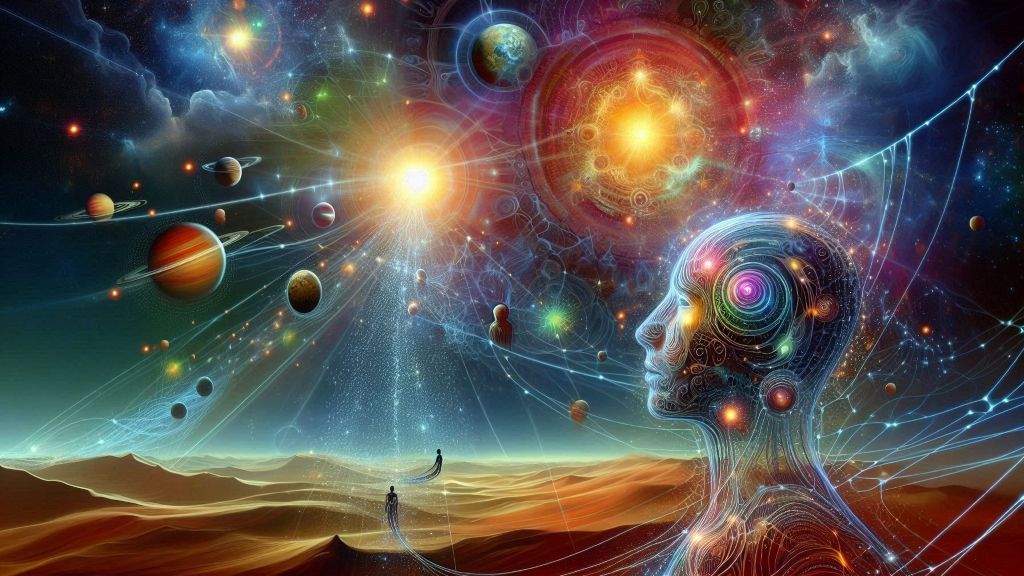 This contemplation may be among the most liberating and enthralling for the Soul, as it opens doors to instantaneous healing, spontaneous forgiveness and absolution, transformation, and even regeneration. Something profoundly enchanting occurs for the Soul when our contemplative focus embraces the unknown future awaiting us. By entering the uncharted and the unknown as a deliberate inquiry, the Soul feels invited to expand into a more spacious domain.
I have chosen to introduce this awareness here before we explore the Self, to empower our journey with a sense of freedom and liberation to embrace a sovereignty that transcends the belief that we are defined by our past. While our past offers valuable learning and essential insight, it does not limit our possibilities or define our true essence.
The Soul Raising the Self
The Soul is a loom of potential — the ground and ecology for the entire human experience, enabling all that a human may become and do.
The Spirit is an omnipresent universal presence and consciousness. The Self is a unique marriage of possibilities and their enactment.
Let us deepen our exploration of the Self and further appreciate the role of the Spirit.
All experiences — feelings, sensations, and states — arise within the ecology of the Soul. The Soul’s conductive presence both enables and mediates our full range of human experience. As we enact these experiences and fashion and weave our own patterns, the Self emerges as a distinct, recognizable configuration. Our fingerprints, iris patterns, and voice signatures, each unique in human history, are physical expressions of this singular Self. And when you add natural inclinations, capacities, character traits, and qualities, the kaleidoscopic variance of each person becomes much greater and a million times more remarkable.
The Self configures itself within the Soul’s field, drawing on her versatility, sustenance, and loom of capacities. The Soul enables the Self to discover its abilities and ways and chart its own path, thereby facilitating the authoring of the Self. As the Self matures and authors its becoming, you gradually come to know your inclinations, qualities, expressive tendencies, and capacities.
It is our broad spectrum of experiences that develop the Self and shape its inner cosmology. Take, for example, learning to ride a bike. Growing up on the kibbutz, there was no children's bike suitable for me to safely learn riding. Instead, at age six, I began riding my father’s full-sized bike, which had a high upper bar. Unable to mount it conventionally, I learned to ride underneath the bar, leaning my body to the left of the bike while pedaling with my right foot, which stretched under the bar to reach the right pedal.
To keep the bike steady, I had to tilt it slightly to the right while my body leaned to the left to counterbalance it. This unconventional approach required a unique balance and coordination, and in the process of mastering it, I crashed many times on the asphalt roads and pavements. For a while, my knees were perpetually scraped and bloodied.
Still, my persistent attempts were supported by the Soul's learning capacity and adaptability. My Soul rejoiced in the can-do freedom and skill that allowed me to swiftly ride into the wind with cheerful zest. Since no one around rode like this, with no examples to follow, I needed to discover this balancing act by myself. The Self that emerged through this experience was shaped by the particular challenges and triumphs of my bicycle journey. Some of the Soul qualities and attributes primed and encoded through my bike-riding adventures and thereby embedded in the configuration of the Self were love of movement, flow, and speed, adventurous daring, recoverability from setbacks, and creative freedom.
Riding the bike became a discovery theater for my Soul, a medium through which the Self came to know and recognize its way and nature. In turn, the Soul, as the enabling ground affording these possibilities, intimately learned to know and support the Self she was raising.
This example reveals the gentle intimacy and attentive care with which the Soul nurtures the Self. At the same time, the developing Self continues to impart and share its experiences, knowledge, and discoveries with the Soul, enhancing their maturing conversation.
The Soul carries the potential for the Self. Without the emergence of the Self, the Soul would remain a source of latent conductive possibilities with no expression or new experience. In this sense, the Self serves as a vehicle of learning and expression for the Soul.
Wherever the Self journeys, the Soul accompanies it, continually affording possibilities, and providing the Self with her parenting and mentorship. Through its experiences, the Self may grow stronger, more potent, versatile, and freer — or conversely, its range may be curtailed and stifled, depending on its engagement with life's opportunities and challenges.
The Fragmenting Self
In Chapter 2, we described the nature of “separation events” and the double anguish they produce. These experiences can impact the configuration of the Self deeply, causing parts of it to become isolated and frozen into separated, unintegrated fragments. These fragmented parts, in turn, tend to generate compensatory acts — ghost-like weak imitations of the original vital states they unconsciously seek to recapture, unknowingly striving to reclaim the wholeness promised by the Soul.
As we deepen our understanding of the cosmology of the Self, we begin to recognize these compensatory ghost acts as signals from the unintegrated fragments, each yearning to be acknowledged and welcomed into the larger cosmology of the Self. Once embraced, these fragments can release their pain and impart their inherent wisdom, energy, and creativity.
The Soul upholds the Self’s chosen patterns and configurations, offering it a "thou mayest" freedom — “you can if you choose” agency. In other words, the Soul does not compel the Self unless it is a matter of life or death; she honors and respects the Self’s authoring agency, allowing it to encounter the lessons essential for its development and for the enrichment of life.
The Soul does, however, provide gentle nudges and cues. She communicates through the evolving shape and luminosity of her field of presence and ecology. In mentoring and companioning the Self, the Soul offers precisely the level of agentic authoring power the Self is ready to embrace. In situations of immediate, life-threatening danger, for example, when you step onto the street and a speeding car hurtles towards you, the Soul’s guardian of life bypasses all other circuits and activates an instinctual reaction, swiftly guiding you to safety.
In the next chapters, we will further explore the fragmented parts of the Self and discover how the Self can liberate and integrate these fragments by cultivating greater wholeness, wholesomeness, and versatility.
The Spirit - A Luminescent Presence
The Spirit, the third element of this interior trinity, remains elusive to direct experience. Its presence, however, deeply influences and shapes us. Though we rarely sense it consciously, its subtle currents flow and permeate every aspect of our lives. In this way, the Spirit’s influence and affect transcends awareness, imbuing the Soul and the broader inner ecology it inhabits with meaning and purpose. 
When the Spirit is pleased — when it finds agreement and resonance with how the Soul guides and nurtures the Self — it flares with greater luminosity and glow. These radiant flares illuminate the Soul, enriching her distinctive glow and amplifying her clarity, conductive buoyancy, versatility, and vitality.
The Spirit can be envisioned as an immortal, glowing spark, an invisible translucent tethering, connecting the Soul to the greater cosmos and its vast, unrealized potential. It affords the Soul a universal compass, orienting and calibrating her towards a higher purpose, facilitating the development and evolution of consciousness in the Universe.
The Spirit carries a higher memory — a timeless awareness that arcs beyond the confines of linear time. This awareness imbues the Soul’s third impulse, that tireless Champion of Purpose, continually attuning itself to this transcendent memory, seeking to embody its wisdom and calling.
We do not experience the Spirit directly but sense its luminous resonance and responsiveness to the Soul’s ecology and the evolving enactment of the Self. When the Spirit glows and glistens brightly with increasing translucence, it radiates outward, illuminating the Soul and our entire field of experiences and actions. Conversely, when the Spirit withdraws or contracts, the Soul’s ecology becomes cloudy, and over time even foggy, impacting our vitality and mood.
In this way, the Spirit’s presence reveals itself and becomes known mostly not as a direct encounter but as an ongoing dialogue — a quiet yet potent conversation with the Soul. Through this emanatory feedback of luminosity, the Spirit guides and elevates both the Soul and the Self, subtly sculpting the cosmology of our inner and outer lives.
Spirit Light
In the previous chapter, we explored several imagery pathways, with the third imagery evoking the vastness of the ocean. I described standing at the shore of the Atlantic Ocean on a beautiful, sunny day. The water is serenely peaceful, gentle ripples rolling in one after another, the endless blue stretching beyond the horizon. Beneath the surface, powerful currents steadily moving, occasionally revealing their presence in the subtle rise and fall of the waves. 
Envision the Soul as a boundless ocean, its rhythmic waves embodying the Self. Now see the Spirit as sunlight: glowing rays that dance across the water’s surface, their sparkling patterns playing with the waves, penetrating the depths, and illuminating hidden realms below.
To complete the picture, imagine those same rays not only streaming from the sun above but also rising from within the ocean itself — radiating inward and outward in a luminous interplay between the Spirit and the Soul. To access the profound awe, inspired by the illuminating power of the Spirit, hold this imagery in your mind. Gradually transpose this connective visualization onto yourself, discovering and feeling the Spirit's emanation as it illuminates you from within and without.
The Next Portal Into the Soul
In this chapter, we invited the Soul to guide us on a meditative journey into antiquity, allowing us to sense and feel the Souls at work during those ancient times. We then turned our contemplation towards the future, discovering the Soul’s power found in the inflection point and pivotal realization that the future is not merely an extension of the past, but a fresh, creative emergence from the latent potentials within the universe. Further, we deepened our understanding of the Self, how it arises from the Soul, and the tethering function of the Spirit.
In the following chapter, we reflect on the profound power of trust and truth available to the Soul and consider how the Self emerges as a laboratory for life's discovery. We then journey into the understanding of separation events through the testimony of one child's personal experience, leading to the point where he enters the Inner Conclave. Here, he is invited to release the burdens he has carried, liberating both the Soul and the Self, allowing them to expand into their natural and greater capacities.
Aviv Shahar
Aviv serves as the Portals' sherpa. He curates transformational journeys and is a storyteller of the epochal evolution culminating at this time. Aviv is the Founder of Aviv Consulting, helping leaders unleash strategic innovation, and is the author of Create New Futures: How Leaders Produce Breakthroughs and Transform the World Through Conversation.
Visit: Aviv Consulting